
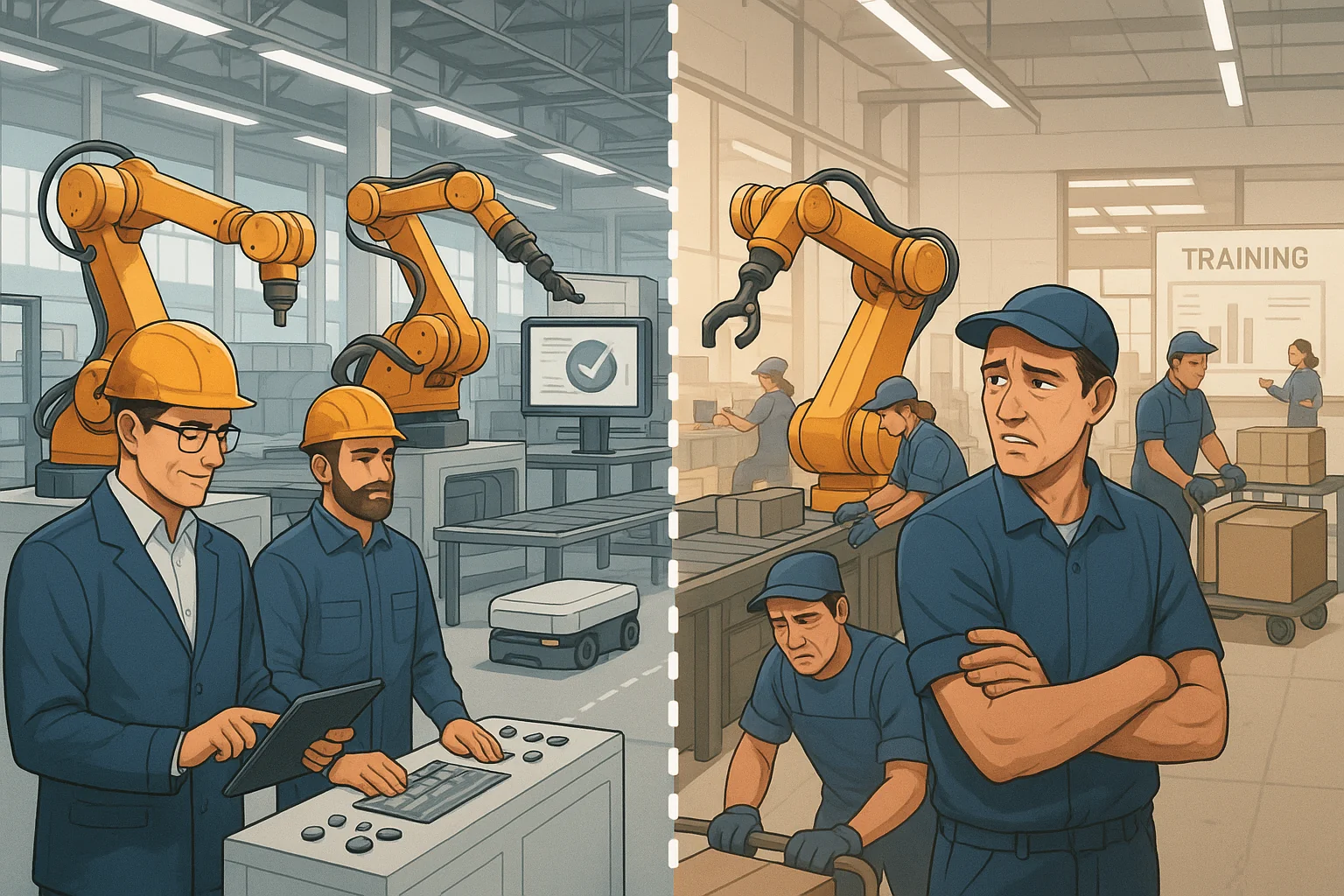

For decades, manufacturing has been the proving ground for new waves of automation—robotic arms on assembly lines, automated guided vehicles in warehouses, AI-driven inspection systems. As these tools become more sophisticated, manufacturers face a pressing question: Will the continued advancement of automation deepen the wage gap between highly skilled and traditional “blue-collar” roles?
The Current Landscape
Manufacturing wages already show a split Production occupations had an annual mean wage of $50,090 (May 2024), while technical automation roles routinely command well above-average salaries. (Bureau of Labor Statistics+1)
- High-skilled technical roles (robotics engineers, automation specialists, data scientists, maintenance technicians with digital expertise) command salaries well above national averages.
- Traditional production roles (line operators, material handlers, assembly workers) remain lower-paid and often face stagnant wage growth, even as living costs rise.
Automation risks amplifying this divide. Firm-level evidence links automation adoption to a rising skill premium, and industry estimates suggest 50–60% of manufacturing activities are automatable — shifting demand toward technical roles. (Nature+1) As machines take over repetitive, manual tasks, demand for low-skill labor could shrink, while demand for skilled technical talent grows.
Why the Gap Could Widen
- Skills Premium – Workers who can program, maintain, and optimize automated systems are in short supply. Scarcity drives up wages. Long-run econometric studies estimate that 50–70% of U.S. wage-structure changes can be tied to task automation and changing occupational demand. (ResearchGate)
- Reduced Low-Skill Demand – Roles that are easiest to automate (basic assembly, packaging, transport) see downward wage pressure as employers invest in machines rather than workers.
- Productivity Gains Concentration – The financial benefits of automation often accrue at the top—management, shareholders, and specialized technical staff—rather than being distributed evenly across the workforce.
Up to 50–60% of manufacturing activities are automatable — a huge opportunity, and a big risk to low-skill wage growth.
Counterforces That Could Mitigate the Divide
While the risk is real, manufacturers are not powerless to shape outcomes:
- Reskilling Programs: Upskilling line workers into automation maintenance, quality control, or data monitoring roles can help them move up the wage ladder instead of being displaced. This creates a growing demand for employees with advanced technical skills trained to operate, maintain, and troubleshoot automated systems.
- Collaborative Robotics (Cobots): In many plants, automation is not a replacement but an enhancement—allowing workers to handle more complex, higher-value tasks while machines do the repetitive work.
- Policy and Incentives: Public–private partnerships, community college programs, and workforce development grants can help smooth transitions for blue-collar workers.
- New Job Categories: Just as past industrial shifts created roles that didn’t exist before (CNC operators, industrial electricians, supply chain analysts), automation may generate opportunities in human–machine coordination, predictive maintenance, and advanced logistics.
Strategic Questions for Manufacturers
To avoid unintentionally widening wage disparity, manufacturers should ask:
- How can we design automation projects with workforce integration in mind, not just cost reduction?
- What structured pathways exist for frontline employees to move into higher-skilled roles within the company?
- Can partnerships with local training providers or trade schools help build a pipeline of future-ready workers?
- How do we communicate clearly with employees about the “why” and “how” of automation, to reduce fear and build trust?
The Bottom Line
Automation will reshape the wage landscape in manufacturing. If left unchecked, it could increase disparities between high-skill and traditional blue-collar roles. But with intentional workforce planning, investment in reskilling, and thoughtful adoption of technology, manufacturers can use automation as a tool not only for efficiency—but also for broadening opportunity.
The real question is less about whether automation widens the gap, and more about how manufacturers choose to deploy it.