
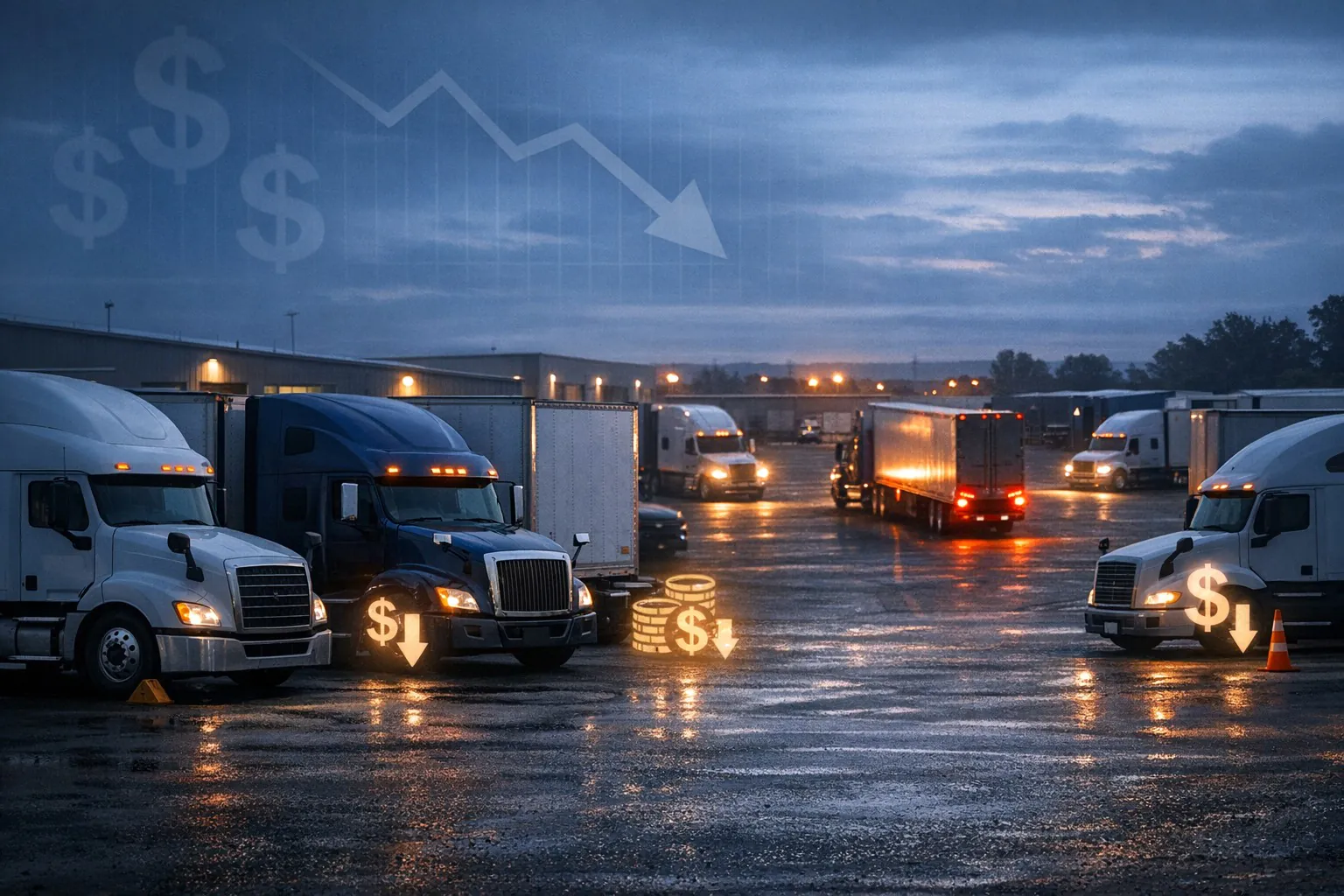

Why “Parked” Doesn’t Mean “Free” in Fleet Operations
Fleet leaders know that trucks in motion create value. But what’s less obvious—and often underestimated—is how much money is lost when trucks aren’t moving. In transportation, idle equipment isn’t neutral. It’s expensive.
From seasonal slowdowns to inefficient routing and network drift, equipment often sits unused longer than planned. The result? A rising idle fleet cost that quietly erodes margins and ties up capital that could be driving business forward.
This breakdown explains why idle trucks cost more than most organizations realize—and why the problem is usually a symptom of deeper design issues.
Many companies assume that if a truck isn’t running, it isn’t costing them anything. In reality, 60–70% of fleet costs are fixed, meaning they accrue regardless of miles driven.
Idle trucks continue to generate costs in four major categories:
1. Depreciation
A truck loses value whether it runs or not. Idle time accelerates cost-per-utilized-mile, making each productive mile more expensive.
2. Insurance and Compliance
Liability insurance, registration, IFTA, safety inspections—these don’t pause when freight slows down.
3. Maintenance
Sitting trucks still require:
Idle equipment can actually need more upkeep, not less.
4. Opportunity Cost
Perhaps the biggest hidden cost:
Every unused truck is capital that isn’t generating freight revenue—or being redeployed to higher-value work.
Idle equipment rarely appears out of nowhere. It’s almost always tied to two operational realities: seasonality and poor fleet design.
1. Seasonality: The Predictable Pattern That’s Hard to Manage
Many industries see freight volumes swing dramatically during certain times of year—construction, agriculture, retail, manufacturing. In peak season, the fleet feels tight. In slow season, trucks sit unused.
The challenge?
Most fleets are sized to meet peak demand, not average demand. That means for 2–6 months per year:
Seasonality creates predictable idle time—but that doesn’t make it harmless.
Without a buffer strategy (like dedicated support or hybrid capacity models), companies absorb 100% of the cost during off-peak periods.
2. Poor Design: Inefficiency That Creeps in Over Time
Idle trucks often signal a deeper structural issue—not a seasonal one.
Common design problems include:
Network Drift
As customers, order patterns, or facility processes evolve, legacy routes become outdated. The fleet may no longer match the true footprint of the network.
Unbalanced Utilization
Some trucks run overloaded while others barely move. This points to:
Aging Equipment Still in Rotation
Even when not needed, older units may remain active on paper, adding avoidable cost.
Reactive Dispatching
When dispatch decisions rely on tribal knowledge, manual adjustments, or last-minute changes, assets fall out of sync with actual demand.
Idle fleet cost is often the byproduct of decisions made months—or years—earlier.
Beyond the immediate financial hit, idle equipment introduces broader operational challenges:
Higher Cost-Per-Mile
Fixed costs spread over fewer miles increase total cost to serve.
Inaccurate Budgeting
Idle assets distort the true cost of transportation, making strategic planning harder.
Reduced Service Flexibility
Idle equipment is often misaligned with where capacity is actually needed.
Lower Driver Satisfaction
Drivers see some routes overloaded while others run short, creating instability and frustrations around pay and scheduling.
Idle equipment isn’t just a cost problem—it’s a signal that the fleet isn’t aligned with the network.
The good news is that idle time is fixable.
Organizations reduce idle fleet cost most effectively when they:
Analyze True Utilization
Not just miles—but hours, load factor, and lane performance.
Model Seasonal Peaks and Valleys
Right-sizing a fleet to average demand while supplementing peak season creates stability and predictable costs.
Redesign Routes Based on Real Demand
Route rebalancing often reveals that fewer trucks can serve the same volume when the design matches the network.
Retire or Reassign Underperforming Assets
Older or consistently underutilized units are prime candidates for elimination.
Adopt Hybrid Capacity Models
Dedicated + supplemental capacity reduces idle time without risking peak performance.
Idle equipment isn’t inevitable—it’s informational. It’s telling you something about your fleet.
The biggest misconception about idle equipment is that it’s harmless. In reality, idle trucks consume budget, tie up capital, and signal deeper inefficiencies across the network.
For fleet-intensive organizations, understanding the true cost of idle assets is an essential first step toward better fleet design, improved utilization, and more predictable operations.
Idle doesn’t mean still.
Idle means expensive.
Let’s Analyze Your Idle Fleet Cost
Learn more about what makes Keller Logistics Group and its affiliates the best choice for your company’s 3PL logistics needs. Contact us to learn more about our services and request a no-obligation quote. Call 419-780-3767 or return our online contact form today.