

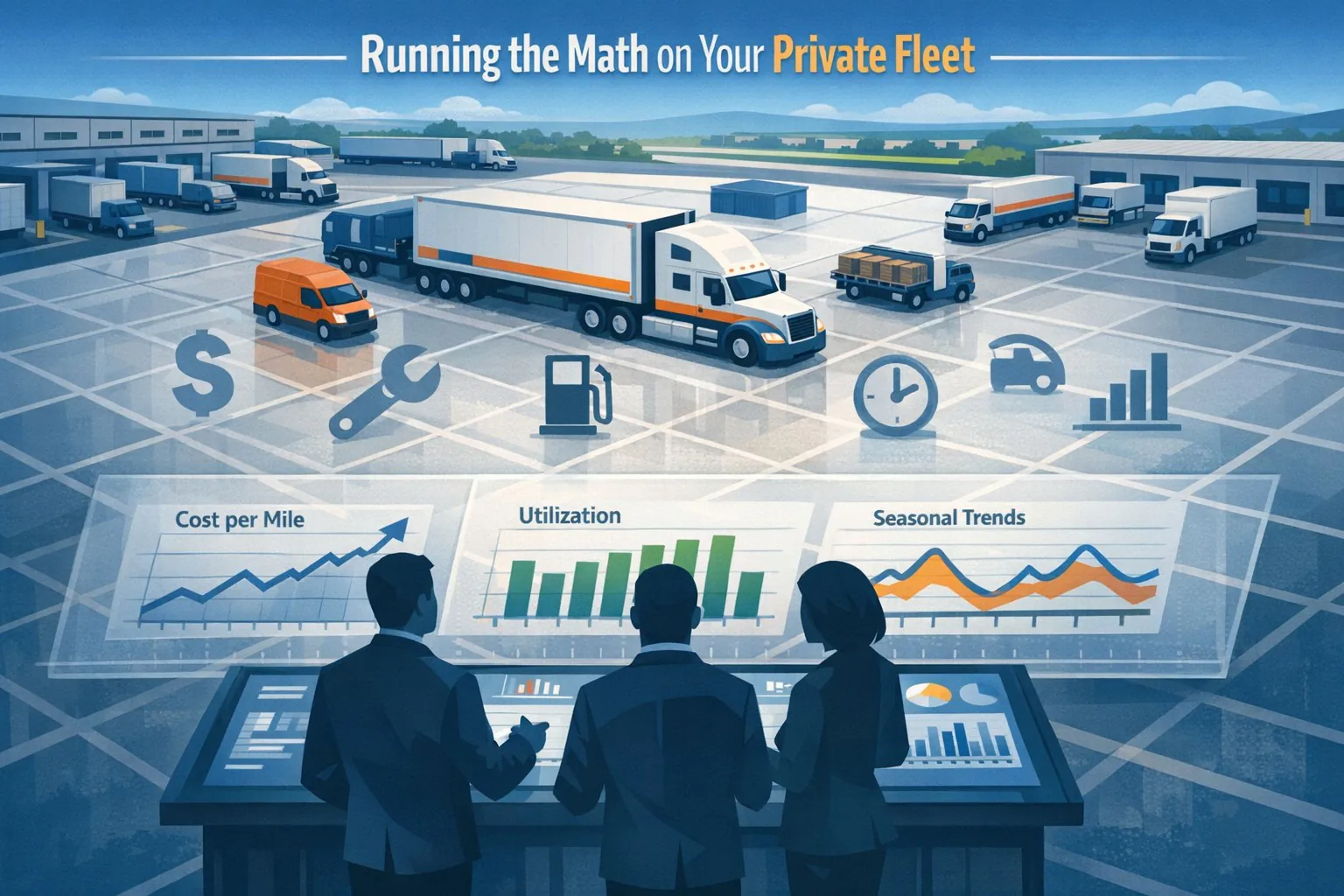

Many organizations rely on private fleets because they believe they offer better control, greater reliability, or lower cost than outsourced alternatives. But as networks evolve and market pressures grow, leaders often reach a pivotal question:
“Is our private fleet still the best economic and operational choice?”
That question can’t be answered by gut feel—or by outdated metrics.
It requires a disciplined fleet cost analysis: a clear, comprehensive look at what the fleet truly costs to run, what value it delivers, and where hidden inefficiencies may be influencing performance.
This guide breaks down what “running the math” really means, the inputs you need to evaluate, the assumptions that shape the analysis, and the strategic decisions that result.
A meaningful fleet cost analysis begins with the raw data. Most fleets track the basics, but leaders often underestimate the number of inputs required for an accurate picture.
Key Cost Inputs Include:
Labor typically represents the largest share of total fleet expense.
These fixed costs accrue whether trucks move or sit idle.
Aging assets can skew these costs dramatically.
These are the variable costs that fluctuate with demand and operational discipline.
These metrics turn cost inputs into meaningful insights about efficiency.
Capturing the inputs is the first step. The next is understanding what they really mean.
1.What Should a Fully Utilized Truck Achieve?
Leaders must define realistic expectations for:
Assumptions must reflect current network realities, not legacy standards.
2.What Is the True Cost Per Mile?
Many fleets underestimate CPM because they:
Accurate CPM requires every fixed and variable cost accounted for.
3.How Do Peaks and Valleys Affect Cost?
Seasonal demand, customer cycles, or production swings change:
Assumptions must reflect these dynamics, not average them out.
4.What Is the Opportunity Cost of Capital?
Trucks tie up capital that could:
A strong fleet cost analysis incorporates the financial opportunity of redeploying capital.
When assumptions are clearly defined, running the math becomes meaningful—not theoretical.
A fleet cost analysis is not just accounting. It’s a strategic decision tool. Once leaders understand the full economic picture, several decisions come into focus.
Decision 1: Should We Right-Size the Fleet?
The analysis often reveals:
Decision 2: Should We Rebuild Our Private Fleet Model?
Math often exposes operational drift:
The decision may be to rebuild the fleet with:
Decision 3: Should We Transition to a Dedicated or Hybrid Model?
When the math shows:
…leaders often explore:
This extends flexibility and reduces financial exposure.
Decision 4: Should We Reinvest, Divest, or Reallocate Capital?
Depending on cost structures:
The math clarifies which path produces the best long-term value.
A thorough fleet cost analysis helps leaders:
Running the math is not an exercise in accounting—it’s a strategy accelerant.
It reveals whether your current fleet model is a true advantage…or a legacy habit.
Private fleets deliver tremendous value when they align with the business and operate efficiently. But that alignment cannot be assumed. It must be evaluated.
A disciplined fleet cost analysis brings structure, transparency, and strategic focus to one of the most expensive and operationally critical parts of the business.
Running the math tells you:

Learn more about what makes Keller Logistics Group and its affiliates the best choice for your company’s 3PL logistics needs. Contact us to learn more about our services and request a no-obligation quote. Call 419-780-3767 or return our online contact form today.